Thursday, April 14, 2011

Bud Break at Shafer Vineyards


Well done Doug Shafer. Such a perfect explanation as to where the valley is this time of year and how delicate the vines are for the months to come. Doug and his growing team work very hard on the maintenance of their vines and are rewarded by wonderful wines. Salute.

View more great stories by following the Napa Vintners on their facebook page.

Thursday, April 7, 2011

Do you mind if I sit here, I'll be texting?

So I'm at the Direct to Consumer Conference (#dtcws) couple months ago and sat through a number of meetings and presentations. I enjoyed each of them and began to post information via twitter and tumblr. I could not help but notice that about 80% of the people in this conference were editorializing just like me and were busy posting information just like me. I took note of the #tag and began to follow the conversation. This lasted a good two hours before it was time for the lunch break.

Being the good school boy I am, I came back from lunch early and decided to change seats so I was closer to the exit - right, don't we all do that? Anyway, apparently there were a number of people who did the exact same thing. I found a seat just past a women three chairs in. Before sitting in the seat I asked, "do you mind if I sit there - I also plan to text while here so I hope that does not offend you?" She kindly smiled and said "no worries, I'm texting too". Cool, I proceeded to take my seat.

So I'm following the #dtcws conversation when all of a sudden the comment comes up "LOL, #dtcws best pickup line of the conference "Do you mind if I sit here, I'll be texting?". I see this and soon realized that the women who wrote that was sitting right next to me. I looked at her, showed her my iPhone and said "is this you?" She said yes with a smile then sheepishly proceeded to get up and leave.

There is no moral to this story other than, I wasn't looking to pickup on anyone, I just thought I was being polite. Second, careful what you say while using social media of any kind, you never know who the person next might be.
Cheers

Wednesday, March 2, 2011

Under the radar, Napa County Green Economy Report is announced.

Napa County Emerging
Green Economy
Even though this report received very little coverage when it was first unveiled January, I wanted you all to make sure you knew where you could downloaded a copy. The Emerging Green Economy report created by the Napa County Work Force Investment Board is available for download on the NCWFIB website http://www.napaworkforce.org/ .

The report is worth the review by both small and large businesses. It outlines the many efforts by local businesses to become more green through self-policing and various certification programs made available throughout the state.

Here’s an excerpt from the executive summary prepared by: Jim Cassio & Associates in association with Craft Consulting Group:
The emerging green economy is generating new job opportunities and a demand for workers with green knowledge, skills, and credentials. These job opportunities include both new jobs and traditional jobs that are adapting to changing market realities. While there is no single agreed upon definition of what constitutes the green economy, there is general consensus on the concept and scope. Broadly defined the green economy describes both: 1) products and services, as well as 2) business practices and processes that dramatically reduce the demand for energy and increase the efficient use of resources. In estimating the number of green jobs, the Bureau of Labor Statistics makes a distinction between establishments that: (1) produce green goods or provide green services and those that (2) use green business practices or environmentally friendly production processes.


Companies producing green products and providing green services cover a number of different market segments that have been described by the Cleantech Group, New Energy Finance, Environmental Business International, US Green Building Council, Next 10, and others. The production of green products and the provision of green services are considered by many to be the core green economy. This core green economy can be divided into various market segments covering clean technology, clean energy, green building, environmental technologies, and other sectors.


Over the past decade, organizations of all types and sizes in nearly every industry sector have started to adopt green business practices. By adopting green business practices businesses can improve their environmental performance while enhancing their bottom line. Third-party verification of green business practices validates a company’s claims that it has achieved a certain level of compliance and/or met the standards established by a credible third-party organization.


Napa County has adopted a certified green business program that is affiliated with ABAG’s Green Business Program and the Napa Green Certified Winery and Land program developed by Napa Valley Vintners. The certified green business and winery program is coordinated by the County’s Environmental Management Department which is responsible for providing information and technical assistance to local businesses about green business practices applicable to their industry. The goal of the Napa Green Business Program is to assist businesses of all types in complying with environmental regulations and going beyond compliance to adopt voluntary standards in four areas: energy-efficiency; water conservation; pollution prevention; and solid and hazardous waste reduction and recycling. Many of the certified green businesses fall into more than one market segment.


For the purposes of this study, to avoid duplication, companies that have adopted green business practices and also produce green products and/or services are listed in the later category and not listed as a certified green business. Green Vineyards and Wineries, for example, were listed only in that category. As a result, this study identified 174 green businesses located in Napa County spread across several green market segments. Green product and service businesses comprise 1.2% of all businesses in Napa County. This compares favorably with the nation (0.9%) and state (1.0%). Almost two-thirds of the green businesses are located in the City of Napa (62.5%) followed by St. Helena (17.9) a distance second, and Calistoga (6.5%) with the third largest number of green businesses. American Canyon has the distinction of being Napa County’s second largest city, but the city with the fewest green businesses per capita.


Almost 95% of the green businesses are small firms with fewer than 100 employees. Green businesses with the largest number of employees include green wineries and remediation firms.


There are approximately 3,687 workers employed in Napa County green businesses. Green business employment represents 5.4% of the total employment in the county. Employment in green businesses cuts across a broad range of industry sectors with manufacturing, business support, and hospitality sectors having the largest number. However, employment in green businesses does not imply all are green jobs. The largest numbers of jobs are in businesses utilizing green business practices and production processes, including sustainable agriculture, green wineries and certified green businesses. Most of the jobs in these sectors involve occupations where there is no significant change in the work or skill requirements.


In contrast, jobs in businesses producing green products or providing green services are nearly always considered to be green jobs. These jobs account for approximately 1% of Napa County’s total private sector jobs. This compares favorably with the Pew study of the nation’s clean energy economy (0.7%) and Next 10’s study of the state’s core green economy (1.2%).


Many of the employers we surveyed seem confident that they will continue to add jobs over the next six months to two years. Although the survey was conducted during tough economic times, the majority of green business employers expect the number of jobs in their company to remain the same, and nearly one in five employers expect to add new workers over the next six months.


Jump to page 7 where the meat of this document begins.
Of the 174 green businesses in Napa County, more than 72 are Green Vineyards or Wineries. This is an impressive number. For a program still in its' infancy, there is a lot of hard working people making this the norm.

The largest green winery employer is Beringer Vineyard and Winery, that claims to have more then 500 employees here’s in the valley. Second comes Rubican Estate, then Charles Krug with 200 and 150 employees respectively.

There’s just some much more to this report, you’ll have to download it yourself.

Tuesday, February 22, 2011

Vintners Hall of Fame dinner at the CIA Greystone

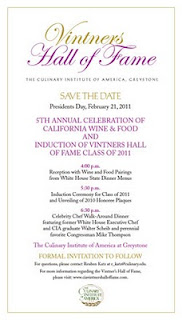
The Official Invitation
Tonight I attended the Vintners Hall of Fame dinner at the Culinary Institute in St. Helena, CA. This is the fifth such event in so many years and thanks to my friends at Nomacorc, I was fortunate enough to be able to attend.

Let me start by saying WOW. I'm not sure what my expectations were before going but this is right up there as one of the "must attend" events in Napa Valley. While three of the inductees were from Sonoma County, the 2011 class of HOF'ers were nothing short of great.

Here's the list of this years inductees:
  • Mr. Richard Graff (1937 - 1998) - Chalone Wine Group
  • Mr. Joel Peterson - Ravenswood (No Wimpy Wines)
  • Mr. August Sebastiani (1913 - 1980) - Sebastiani Winery
  • Professor Vernon Singleton - U.C. Davis Department of Viticulture and Enology
  • Louis "Bob" Trinchero - Sutter Home Winery
First there was the grazing before the induction of this class. The theme for the night was "Presidents Day" - get it? The wines poured during the initial reception featured wines poured at dinners at the White House - not Nickel and Nickel - the place where the President lives.
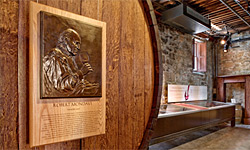
Vintner Hall of Fame - Free to the Public
Surrounded by previous hall-of-fame winners appearing in bronze busts on giant half-barrels and located within the second floor barrel room of CIA, there were ten (10) wineries being presented with example menus and cuisine from their respective night at the White House. The wineries included: Buena Vista Carneros, Chimney Rock Winery, Concannon Vineyard, Grgich Hills Estate, Iron Horse Vineyards, Jordan Vineyards & Winery, Korbel Champagne Cellars, Landmark Vineyards, Robert Mondavi Winery, and Schramsberg Vineyards. Someone asked me if I had a favorite. Well, I liked them all. As a native Californian it's wonderful to know these wineries represented us at the White House. It's a great opportunity for these wineries and we should be proud of them. Through the 80s we can attribute a lot of the pouring of CA wine to our California Chef Walter Scheib (CIA Grad '79) - The American Chef. No other Chef has promoted our California cuisine or wine better then he does. For those who may have never heard of Chef Walter (you must be in a wine cave), he was the Executive Chef for two presidents - Clinton and Bush - and authored the book White House Chef.

Chef Walter Scheib
After the grazing it was time for the induction speeches. What a fabulous tribute to the inductees. Once the speeches had concluded, Chef Walter Scheib lead us up to the top floor of CIA to the Teaching Kitchen. This space is surrounded by workstations where during the day 100+ students practice their trade with real-life tools-of-the-trade. Here among standing-room-only tables, seven more Chef's featured an amazing tour of culinary delight and of course more wine pairings. NOTE: You have to show some discipline at these types of events. The Valley is a dangerous place to drive so I always recommend spitting. Yes I said it - spit, taste then spit. The pleasure for me comes in the form of the taste and not getting plowed. Besides, you can appreciate the various characteristics of the wines if you take your time and taste. Thank you Todd Humphries (amazing mushroom soup); Polly Lappetito, Dominic Orsini, Jeffrey Starr, David Thater and Congressman Mike Thompson for a wonderful tour of epi-delight. BTW - Congressman Mike Thompson had a wonderful asparagus risotto - I coined the name "Blue Dog Risotto" - guess you had to be there. Chef Walter also mixed it up with his fabulous sesame-crusted halibut with curried sweet potato soup - yumm.

Brother Timothy - Inducted 2007
The night concluded with a glance over my shoulder at the beautiful Greystone buildings and a thought of the dedicated Christian Brothers - and Brother Timothy - would he (they) be proud of tonight? People Magazine once asked Brother Tim - "In a religious order devoted to education, how does Brother Timothy justify his vocation?"  "Oh, gosh," he replied. "I can answer that a thousand different ways. Wine-making is an art form—it expresses something of yourself. And in the Scripture, the first miracle Christ performed was turning water into wine. If Christ made wine, I don't feel ashamed to be involved with it."

Salute Brother Tim!

Monday, February 14, 2011

The results are in - 2010 Crush Report

The report is final and in the hands of the press throughout the globe. Here is an excerpt from the introduction from the report.
SUMMARY OF GRAPE TONNAGES AND PRICES
The 2010 crush totaled 3,980,229 tons, down 3 percent from the 2009 crush of 4,095,297 tons. Red wine varieties accounted for the largest share of all grapes crushed, at 2,047,766 tons, down 1 percent from 2009. The 2010 white wine variety crush totaled 1,535,133 tons, down 6 percent from 2009. Tons crushed of raisin type varieties totaled 273,577, down 11 percent from 2009, and tons crushed of table type varieties totaled 123,753, up 46 percent from 2009. 
Beginning with the 1999 season, the Grape Crush Report includes the total number of tons crushed for concentrate production. In determining grape tonnage crushed for concentrate production, each processor was required to report the estimated equivalent tons of grapes crushed for grape concentrate. For the 2010 season, this total was 535,794 tons, approximately 13 percent of the 2010 grape crush total. This report provides only the aggregate figure for grapes crushed for concentrate production and does not include information by district, type, or variety.
The 2010 average price of all varieties was $543.03, down 5 percent from 2009. Average prices for the 2010 crop by type were as follows: red wine grapes, $625.19, down 7 percent from 2009; white wine grapes, $500.37, down 7 percent from 2009; raisin grapes, $209.32, up 22 percent; and table grapes, $173.81, up 21 percent.
To view the entire report click here.

Friday, February 11, 2011

GOVERNOR BROWN APPOINTS CRAIG MCNAMARA

Is this good for our wine industry?

GOVERNOR BROWN APPOINTS CRAIG MCNAMARA AS PRESIDENT OF THE CALIFORNIA STATE BOARD OF FOOD AND AGRICULTURE

Release #11-005
Print This Release
SACRAMENTO, February 10, 2011– Governor Jerry Brown has named Craig McNamara as president of the California State Board of Food and Agriculture.
“Governor Brown has made an excellent choice in appointing Craig as president of the board,” said CDFA Secretary Karen Ross. “Craig is dedicated to the agricultural community of this state and will work tirelessly to ensure the sustainability of our food and farming system. California’s farmers and ranchers, along with our diverse stakeholder community, can have no better champion.”

McNamara has served on the California State Board of Food and Agriculture since 2002. McNamara has been the president of the Center for Land-Based Learning since 1993 and the president of Sierra Orchards since 1980. Previously, he was a partner at Bountiful Harvest Food Company. McNamara is a member of the Public Policy Institute of California, the American Farmland Trust and Roots of Change.

The California State Board of Food and Agriculture advises the governor and secretary of food and agriculture of findings as they impact agriculture and consumer needs. The board conducts forums that bring together local, state, and federal government officials, agricultural representatives, and citizens to discuss current issues of concern to California agriculture.

The next meeting of the California State Board of Food and Agriculture is scheduled for February 23, 2011 at CDFA.